
Why do smart home quotes for the same house differ so much?
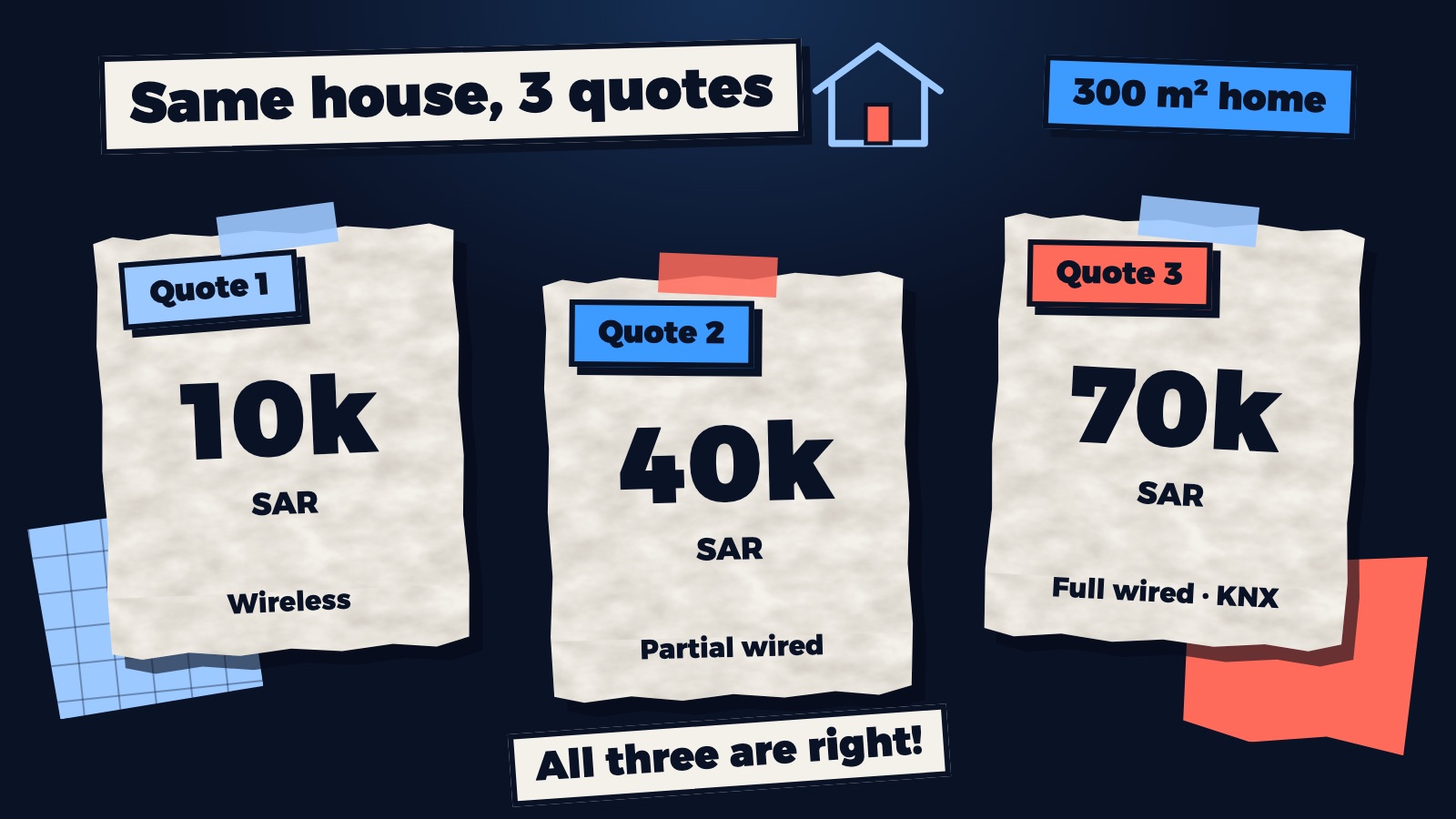
You ask three companies to quote the same house. One comes back at SAR 70,000, the second at 40,000 and the third at 10,000. All three can be right, but each one is pricing something completely different.
The problem is that most line items mean nothing to the homeowner, so they compare the bottom line only. That's not your fault; even engineers who don't specialise in smart homes struggle with it. And every company has a pitch: longer warranty, European brand, "Chinese is good enough now". The result is what marketers call choice overload.
"Want to confuse someone? Give them options."Eng. Islam Abdelwahab
The example in this article is a real house: 300 m², two floors (ground and first) with a small annex. Let's break down the three numbers one by one.
SAR 10,000: a wireless system
The cheapest quote is usually a wireless system from a Chinese brand, with full control of lighting, AC, curtains and intercom.
It's cheap because wireless needs no pre-wiring: the electrician installs a smart switch instead of a regular one as part of the normal electrical work. No extra cables, no breaking walls.
Who is it for? For an apartment, the advice is usually wireless, because wired would be expensive for an apartment. Wired is far more robust, but here it's a budget decision.
SAR 40,000: partial wired, and every goal has a price
The 40k quote is usually a partial wired system: not the whole house, only what you need, such as lighting and AC.
This is where your price is decided: what do you want from your smart home?
- Saving energy: you need a device that reads consumption, plus lighting and AC control. Curtains aren't essential here, so you save their cost.
- Comfort: you want to control everything, which leads to the third quote.
- Luxury and showing off: screens, effects and a show for guests, all of which raise the number.
A technical note: curtains aren't essential for saving energy, but smart curtains can run a scenario that closes them automatically when the temperature hits a certain level or at midday, so the AC works less and you save energy indirectly.
"If you walk into a company without knowing your goal, it's like walking into a mall shop where the salespeople pounce and sell you items you don't need."Eng. Islam Abdelwahab
SAR 70,000: full wired with KNX
The 70k quote is roughly the cost of a full wired system from a European brand running on KNX: devices, installation and programming. If you're building a villa and still at the pre-wiring stage, the answer is clear: go for a wired system.
| Wireless | Partial wired | Full wired KNX | |
|---|---|---|---|
| Approx. cost (300 m²) | ~SAR 10,000 | ~SAR 40,000 | ~SAR 70,000+ |
| Needs pre-wiring? | No | Yes | Yes (SAR 5–6k) |
| Covers | Lighting, AC, curtains, intercom | Only what you need (e.g. lighting and AC) | The whole house |
| Typical brand | Chinese | Depends on the quote | European |
| Best for | Apartments and finished homes | A clear goal (saving, or lighting and AC) | Villas at the pre-wiring stage |
How much does smart home pre-wiring cost?
The 70k covers devices, installation and programming. Pre-wiring costs roughly SAR 5,000–6,000 at most, and the 70k comes later at the finishing stage. So you don't pay everything at once, and you can plan the budget comfortably.
If you skip pre-wiring and want a wired system later, you'll pay for breaking walls, paint and gypsum on top of the system price. Pre-wiring is the cheapest part of the project, so don't be afraid of it.
Tip: run extra Cat 6 cables and extra speaker wires. Running a cable doesn't commit you to buying anything; a cable to a camera point doesn't mean you have to install a camera.
Why do some quotes go above 70k?
Because the devices themselves vary in price. Take the control screen: in a wired system there's one at around SAR 2,000 and another that reaches SAR 10,000, with the same core functions; the difference is in design, materials and extra features. In wireless, the screen is very cheap. The same goes for switches, intercom and everything else.
So if two quotes for the same system are far apart, ask: which devices exactly? Sometimes the whole difference is one item.
Installation, programming and after-sales: the most important line
Installation and programming aren't a fixed percentage because each device takes a certain time, but in general they're rarely less than 20% of the materials cost.
They matter because you can buy the best brand on the market and, without a good engineer and technicians, still end up suffering and regretting the day you went smart.
The second reason this line is expensive is after-sales service: who answers when something stops working after handover. Good after-sales is the difference between a happy smart home owner and one who regrets installing it.
"If this line looks expensive, don't run. Ask what value you get for it. What should really worry you is when it's very low."Eng. Islam Abdelwahab
Ask to see projects they've delivered, and have them walk you through the steps from drawings to handover.
Find the right option for your home
Before you call any company, answer 4 questions and get a ready-made quote sheet you can send to any company, or to me on WhatsApp.
1Villa or apartment?
2What stage is the house at?
3What's your main goal?
4What do you want to control?
Approximate prices for a 300 m² home; they vary with size and the devices you choose.
Watch the video

The video is in Arabic with English subtitles (6:11).
Frequently asked questions
How much does a smart home cost in Saudi Arabia?
For a 300 m² home, including devices, installation and programming: about SAR 10,000 wireless, about SAR 40,000 partial wired, and about SAR 70,000 full wired KNX, possibly more depending on the devices. Wired systems also need pre-wiring at SAR 5,000–6,000 at most.
How much does smart home pre-wiring cost?
Roughly SAR 5,000–6,000 at most for a 300 m² home, paid during construction; devices and programming come later at finishing. If you skip it and want wired later, you'll pay for breaking walls, paint and gypsum on top of the system price.
Is wireless or wired better for an apartment?
Usually wireless, since there's no pre-wiring and no breaking walls. Wired is more robust but expensive for an apartment. For a villa under construction, wired is the better choice.
Why do smart home quotes for the same house differ so much?
Each company prices something different: system type, brand, what you want to control and the devices themselves. Define your goal and what you want to control, ask for quotes on that basis, and prices will be much closer.
What share of a smart home quote is installation and programming?
It isn't a fixed percentage, but it's rarely less than 20% of the materials cost. The real warning sign is when this line is very low.
Got 3 quotes and can't decide?
Send me your home's size and whether it's a villa or apartment, and I'll give you a rough cost and the line items to ask about.
Message me on WhatsApp